
Distracted Driving in Ontario
Distracted driving is not a rare mistake. It is a daily pattern. Many drivers believe they can handle a quick glance. They believe they can multitask. The truth is simple. Attention is finite. Driving demands attention every second because risk changes every second.
Distracted driving is not only phones. It includes eating, adjusting music, searching for items, talking to passengers, and even driving while emotionally upset. Phones remain the biggest trigger because they are designed to pull you back in.
The Problem
The biggest problem is that distraction feels harmless in the moment. A driver tells themselves it is just one second. That one second becomes two. Then three. Then the driver looks up and traffic has changed.
Distraction also creates false confidence. People who have done it many times without crashing start to believe they are safe doing it. They are not safe. They have been lucky.
Distraction is especially dangerous for new drivers because their driving skills are not automatic yet. They need more focus to stay in lane, keep speed steady, and judge gaps. Any distraction hits harder.
The risks
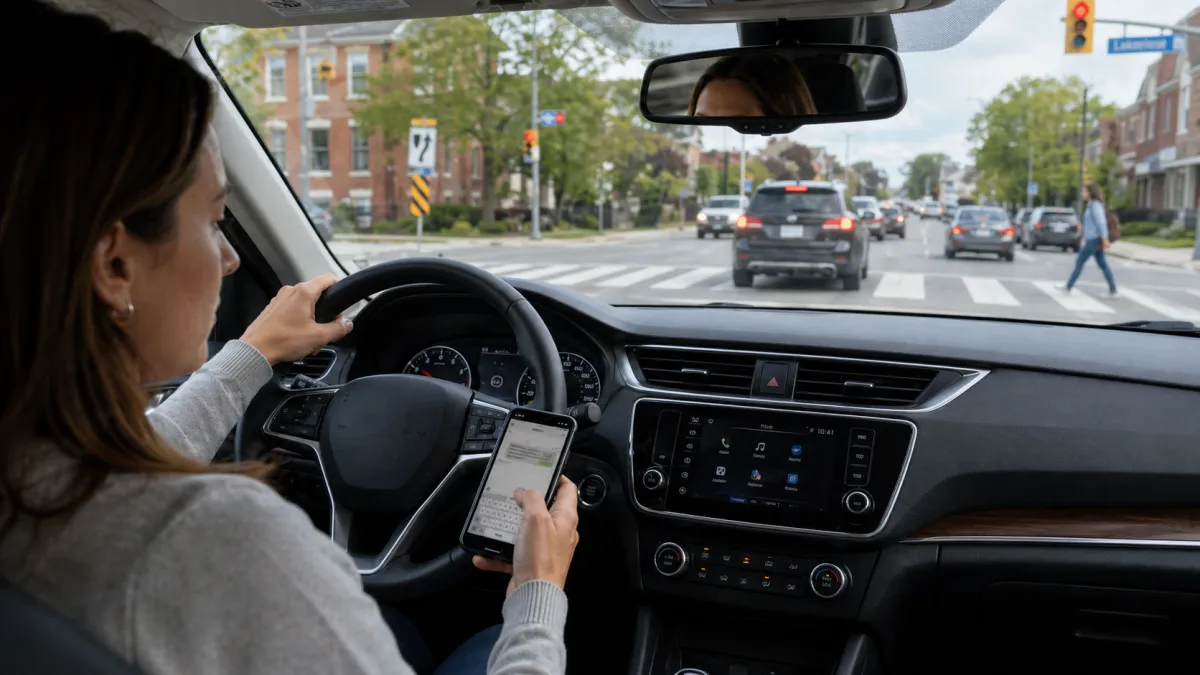
Distracted driving increases reaction time. It reduces scanning. It leads to drifting across lanes, missing brake lights, and late stops. It leads to rear end crashes, intersection collisions, and hitting pedestrians or cyclists.
At highway speeds, the risk multiplies because distance covered is large. Even a short distraction can cover a long stretch of road. In city driving, the risk is intense because hazards appear quickly and the environment is dense.
Distraction also creates a chain reaction. A distracted driver brakes late. The car behind brakes hard. Someone swerves. That is how pile ups start.
Tips that work
You reduce distraction by removing the triggers before driving.
Tip 1: Make your phone physically unreachable
Put it in the glove box. Put it in a bag in the back seat. If you must use it for navigation, mount it, set the route before moving, then do not touch it again.
If you cannot reach it, you will not use it.
Tip 2: Use driving mode and silence notifications
Turn on do not disturb while driving. Silence notifications. Remove the temptation. If you are waiting for an important call, pull over and take it safely.
Tip 3: Use a one minute pre drive routine
Before you move, do these tasks while parked. Seatbelt. Mirrors. Climate. Music. Navigation. Then drive.
This routine prevents the common pattern where drivers adjust things while moving.
Tip 4: Create passenger rules
Passengers can help or hurt. A calm passenger can support the driver. A loud passenger can become a hazard.
For teens and new drivers, limit passengers early. Fewer passengers means fewer distractions and less pressure to perform.
For adults, set a rule in the car. If the driver needs focus, conversation pauses.
Tip 5: Pull over when you need to handle something
Drivers often push through because they do not want to stop. Stopping is the safe choice.
If you need to reply to a message, pull over safely. If you are upset, pull over and breathe. If your child needs help in the back seat, pull over. Driving while distracted is gambling.
Tip 6: Teach workplaces and families a response expectation
Many distraction events happen because people feel forced to respond instantly. Fix that culture. Tell your team and your family, “I respond when parked.”
That single expectation change reduces pressure.
Solutions from Drive Safe Foundation
Distracted driving is a serious issue on Brantford roads and across Southern Ontario because traffic is dense and speeds change quickly. A short glance at a phone can cause a rear end crash or a missed pedestrian, especially near school zones and busy corridors. Drivers travelling to Hamilton, Cambridge, or Toronto using Highway 403 face even higher risk because distance covered is large in seconds. Drive Safe Foundation teaches distraction prevention as a practical system, not a lecture. Contact us to book a distracted driving education session for your school, workplace, or community group in Brantford.
Related Article: Youth Driver Safety in Ontario

Drive Safe Foundation is a non-for-profit, independent educational organization. All programs and resources are provided free of charge. We do not receive commissions or referral fees from driving schools or insurance providers.
Contact Us
Safdar Ali
Executive Director
Drive Safe Foundation
66 Wilkes StreetBrantford, Ontario N3T 0H7, Canada
Reach out to Drive Safe Foundation to find out how can we support you.
Drive Safe Foundation is a registered Ontario Non-Profit (Corp. No. 1001479596)